
Key Takeaways
- Number sense includes understanding quantity, order, size, patterns, and number relationships.
- Short, repeatable games can create meaningful practice with less worksheet fatigue.
- Math talk matters. Asking children to explain their choices reveals how they are thinking.
- The same challenge can be adjusted by changing the number range, rules, materials, or level of support.
- Games work best alongside clear instruction and guided conversation.
Children build number sense when they do more than recite numbers or memorize answers. They learn to notice quantities, compare amounts, see patterns, and choose strategies. Simple Math and STEM board games can give families and educators an engaging setting for that kind of thinking, especially when adults focus on the math behind each move. This approach can help children connect mathematical ideas with practical problem-solving.
Play does not need expensive materials or long lessons. Dice, cards, counters, blocks, paper, and everyday objects can become useful math tools when a challenge asks a child to predict, test an idea, explain an answer, or try a different approach. These simple activities can make mathematical thinking feel approachable and relevant during everyday play.
What Number Sense Looks Like in Daily Life
Number sense is a flexible feel for how numbers work. A child with developing number sense may recognize that 8 is more than 5, know that 7 can be split into 4 and 3, or estimate that one pile of crackers has about twice as many as another. This is different from repeating number names in order without connecting those words to actual amounts.
Daily routines offer natural examples. Children use number sense when sharing snacks fairly, deciding whether there are enough plates for everyone, measuring ingredients, counting steps, comparing prices, or figuring out how much time remains before leaving. Those early ideas support later work with operations, fractions, measurement, algebra, and data.
Why Play Gives Math Practice a Purpose
A well-designed game gives math a reason. Reaching a target, filling a board, making the largest total, or finding a hidden pattern requires children to use numbers in service of a goal. Turns also create repeated opportunities to count, compare, plan, and revise a strategy.
Play can make mistakes feel less final. A wrong move becomes information for the next round, not simply an answer to erase. Still, a game alone is not the lesson. Adults can make the learning clearer by naming the idea involved, such as “You chose 9 because it is closer to 10,” or “You counted each space once.”
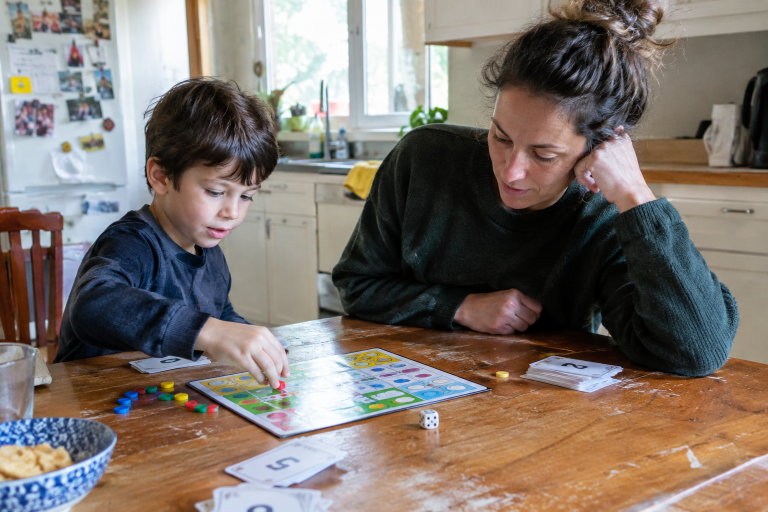
Five Skills Play-Based Challenges Can Strengthen
1. Counting and One-to-One Matching
Use tokens, toy cars, buttons, or jumps to match one number word to one object or movement. Ask children to place five counters on a mat, move four spaces on a path, or count out enough cups for a pretend picnic. The important idea is cardinality: the final number said tells how many are in the set.
2. Comparing Quantities
Dice, dominoes, and cards are useful for asking “Which has more, fewer, or the same?” Instead of accepting a quick guess, ask, “How do you know?” A child might count both groups, match objects one-to-one, or recognize a familiar dot pattern.
3. Part-Part-Whole Thinking
Invite children to make one number in several ways. Seven can be 5 and 2, 4 and 3, or 6 and 1. Try a target-number challenge with counters: “Can you make 10? Can you find another way?” This supports addition and subtraction by showing that a total can stay the same while its parts change.
4. Patterns and Sequences
Create repeating patterns with colors, shapes, claps, movements, or numbers. Ask what comes next and how the child knows. As challenges grow, use skip-counting patterns, input-output rules, or shape sequences that require children to describe the rule rather than only complete the pattern.
5. Estimation and Mental Math
Before counting a jar of objects or solving a total, ask for a reasonable estimate. Then compare the estimate with the result. The goal is not an exact first guess. It is noticing clues, such as the size of a group, a familiar benchmark, or how close a number is to a target.
Simple Challenges for Different Age Groups
Preschool and Kindergarten
- Match numeral cards to groups of objects.
- Sort objects by color, size, or shape, then count each group.
- Compare two collections using more, less, and same.
- Move along a number path while saying one number for each space.
Early Elementary School
- Roll the dice and build a target sum with counters or drawings.
- Find several ways to make the same total.
- Estimate an answer before solving a brief story problem.
- Use bundles or place-value drawings to represent two-digit numbers.
Upper Elementary School
- Compare fractions with visual models.
- Build arrays to represent multiplication facts.
- Record repeated game outcomes to discuss probability.
- Choose between strategies and explain which one is more efficient.
How to Choose and Adapt a Useful Math Game
Start with one skill, such as counting, comparing, operations, patterns, space, money, or probability. Then choose an activity that is challenging but not confusing. Useful games include meaningful choices, short turns, and more than one possible strategy. They should not reward random guessing or make speed the only measure of success.
Adjust one feature at a time. Reduce the number range, add a number line, use objects before symbols, remove a timer, or let a child work with a partner. For more challenge, add a target number, require two solution methods, or ask the child to invent a new rule.
Questions Adults Can Ask During Play
- How did you figure that out?
- Can you show your thinking with objects, a drawing, or words?
- Which number is closer to the target?
- Can you find another way?
- What do you predict will happen next?
- Would your plan change if the number were larger?
Using Research Without Taking the Fun Away
Guided play is most useful when the challenge has a clear mathematical focus, and the adult pays attention to the child’s reasoning. For example, number-path games can support counting, numeral recognition, and comparison language while giving adults a chance to observe whether children match each move to one counted space.
Children also benefit from games that can be revisited with slightly different rules. The National Association for the Education of Young Children notes that dot-card and finger games can explore counting, comparing, and composing numbers, making them practical choices for short sessions at home or in a classroom.
A Quick 15-Minute Math Play Routine
- Warm up for two minutes: Count, sort, compare, or identify a pattern.
- Play for eight minutes: Use one clear challenge and simple materials.
- Pause for three minutes: Ask the child to explain one decision or strategy.
- Finish for two minutes: Change one rule and predict what will happen.
How to Tell If the Activity Is Helping
Look for gradual changes rather than perfect performance. A helpful challenge may lead a child to explain an answer with less prompting, notice patterns independently, represent an idea with objects or drawings, attempt a second strategy after the first fails, or use the same math idea in a new situation.
Conclusion
Play-based math challenges are most valuable when children think, talk, test ideas, and try again. A brief game can build more than calculation speed. It can help children see relationships among numbers and become more confident problem solvers. With simple materials, thoughtful questions, and steady guidance, play can become a practical part of everyday math learning.


